
Right now, there is a Loan Estimate sitting on your kitchen table, and the monthly payment attached to it is making your stomach turn.
You negotiated hard on the purchase price, but the interest rate environment of 2026 is unforgiving. As you review the closing documents, your loan officer casually throws out a lifeline: “If you want, you can pay a few discount points to buy down your rate. It will save you $80 a month.”
They make it sound like a simple, risk-free menu option.
It isn’t. Buying mortgage points is essentially a high-stakes gamble against the calendar. You are fronting thousands of dollars of your own hard-earned liquidity on the bet that you will stay in this specific house, with this specific loan, long enough to make that money back. If you guess wrong, you don’t just lose out on savings; you effectively hand the bank a massive, unearned bonus.
Lenders push discount points because it secures their yield upfront. For you, the decision should never be based on the emotional relief of a slightly smaller monthly bill. It must be based entirely on cold, hard mathematics.
Here is the unfiltered truth about when to pay points to lower your rate, when to hoard your cash, and how to calculate the exact month the bank stops winning and you start saving.
Stripping Away the Jargon: What Are You Actually Buying?
Before we run the numbers, you need to understand the mechanics of the transaction. The banking industry loves to use the phrase “discount points” because it sounds like you are getting a deal at a retail store.
You are not getting a discount. You are prepaying your interest.
One “point” equals exactly 1% of your total loan amount. If you are taking out a $400,000 mortgage to buy a home, one point costs you $4,000 in cash, due immediately on closing day.
In exchange for handing over that $4,000, the lender will typically lower your permanent interest rate by about 0.25%. (This reduction fluctuates daily based on bond markets, but a quarter-percent is the standard industry benchmark).
So, you are draining your bank account today to buy a microscopic reduction in your monthly payment for tomorrow.
The Emotional Trap of the “Lower Payment”
The psychological pressure of buying a house is immense, especially for first-time buyers. When a loan officer tells you that paying $6,000 in points will drop your payment from $2,800 to $2,690, your brain instantly latches onto the relief of that $110 monthly savings. It feels like breathing room. It feels like security.
But financial preservation requires looking past the monthly cycle.
When you drain your cash reserves to buy down a rate, you are deliberately starving your emergency fund. Houses are notoriously expensive to maintain. If the HVAC system dies six months after you move in, that $110 a month you saved on your mortgage payment is completely useless if you no longer have the $6,000 in cash required to replace the furnace.
You must protect your liquidity first. Never pay points if doing so leaves you with less than six months of cash reserves after closing.
The Only Metric That Matters: The Break-Even Horizon
If you have the cash, the entire decision hinges on one single formula: the break-even point. This is the exact month where the upfront cash you paid equals the monthly savings you accumulated.
If you sell the house or refinance the loan before this month, you lose money. If you hold the loan after this month, the strategy was a success.
Let’s run a real-world 2026 scenario:
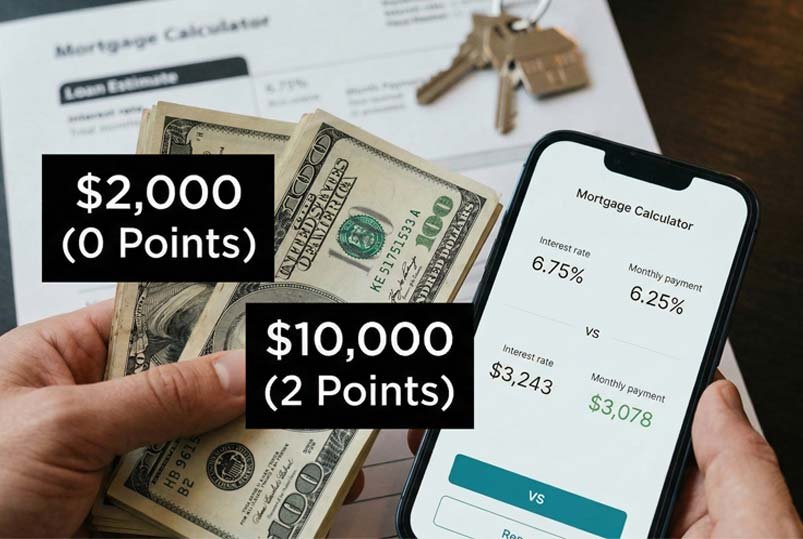
You are borrowing $500,000 on a 30-year fixed mortgage. The lender offers you a base rate of 6.75%. Your principal and interest payment is $3,243. They offer you the option to buy 2 points to drop the rate to 6.25%.
- The Cost: 2 points on a $500,000 loan will cost you $10,000 out of pocket at closing.
- The Savings: The new 6.25% rate drops your payment to $3,078. You are saving $165 every month.
- The Formula: Divide the upfront cost ($10,000) by the monthly savings ($165).
The Result: 60.6 months.
It will take you exactly five years and one month just to get your own money back. You do not save a single true dollar until month 61.
Statistically, the average American homeowner either sells their home or refinances their mortgage every five to seven years. If you pay $10,000 in points today, and interest rates drop significantly in three years, you will absolutely want to refinance to capture the new, lower market rate. But if you do, that $10,000 you paid for the points simply vanishes. You forfeit it entirely.
The Silent Wealth Killer: Opportunity Cost
To be truly rigorous with your wealth, you cannot just look at the break-even timeline. You must look at the opportunity cost of the cash.
What else could that $10,000 have done for you over those 60 months?
If you had skipped the points, taken the slightly higher monthly payment, and invested that $10,000 in a standard S&P 500 index fund returning a conservative 7% annually, that money would grow to over $14,000 in five years.
When you buy points, you are essentially locking your cash into a fixed, illiquid return (your interest savings). You are trading the compounding growth of the stock market for a slight reduction in debt liability. Unless you plan to stay in the home for a decade or more, the math rarely favors the mortgage buy-down.
When Paying Points is a Financial Masterstroke
Despite the harsh realities of the break-even timeline, there are two distinct scenarios where buying points is an incredibly sharp financial move.
1. Using the Seller’s Money In a stabilizing housing market, sellers are often willing to offer “concessions” to get a deal closed. They might offer $8,000 toward your closing costs instead of dropping the purchase price. This is the holy grail of mortgage strategy. If you use the seller’s money to buy down your interest rate, your break-even point is effectively zero. You are permanently lowering your monthly liability using someone else’s equity. If you can negotiate seller credits, always use them to buy points.
2. The Verified Forever Home If you are buying a home in your ideal school district, your career is deeply anchored to the city, and you know with absolute certainty that you will not move for the next fifteen to twenty years, buying points makes sense. Over a twenty-year horizon, a $10,000 upfront investment could yield $30,000 or more in total interest savings. The longer the timeline, the more devastatingly effective the points become.
The Verdict on Rate Buy-Downs
Do not let a loan officer rush you into a decision based on the immediate gratification of a cheaper monthly payment.
Mortgage points are not a trick, but they are a highly specific financial tool designed for long-term stability. If this is a starter home, a transition city, or if you suspect you might need to tap into your home’s equity in the next few years, keep your cash in your bank account. Protect your liquidity, accept the current market rate, and wait for a favorable window to refinance later without having sunk thousands into upfront fees.
Treat your mortgage like the massive financial anchor it is. Run the break-even math, calculate your opportunity cost, and make the bank earn their yield the hard way.
Be First to Comment